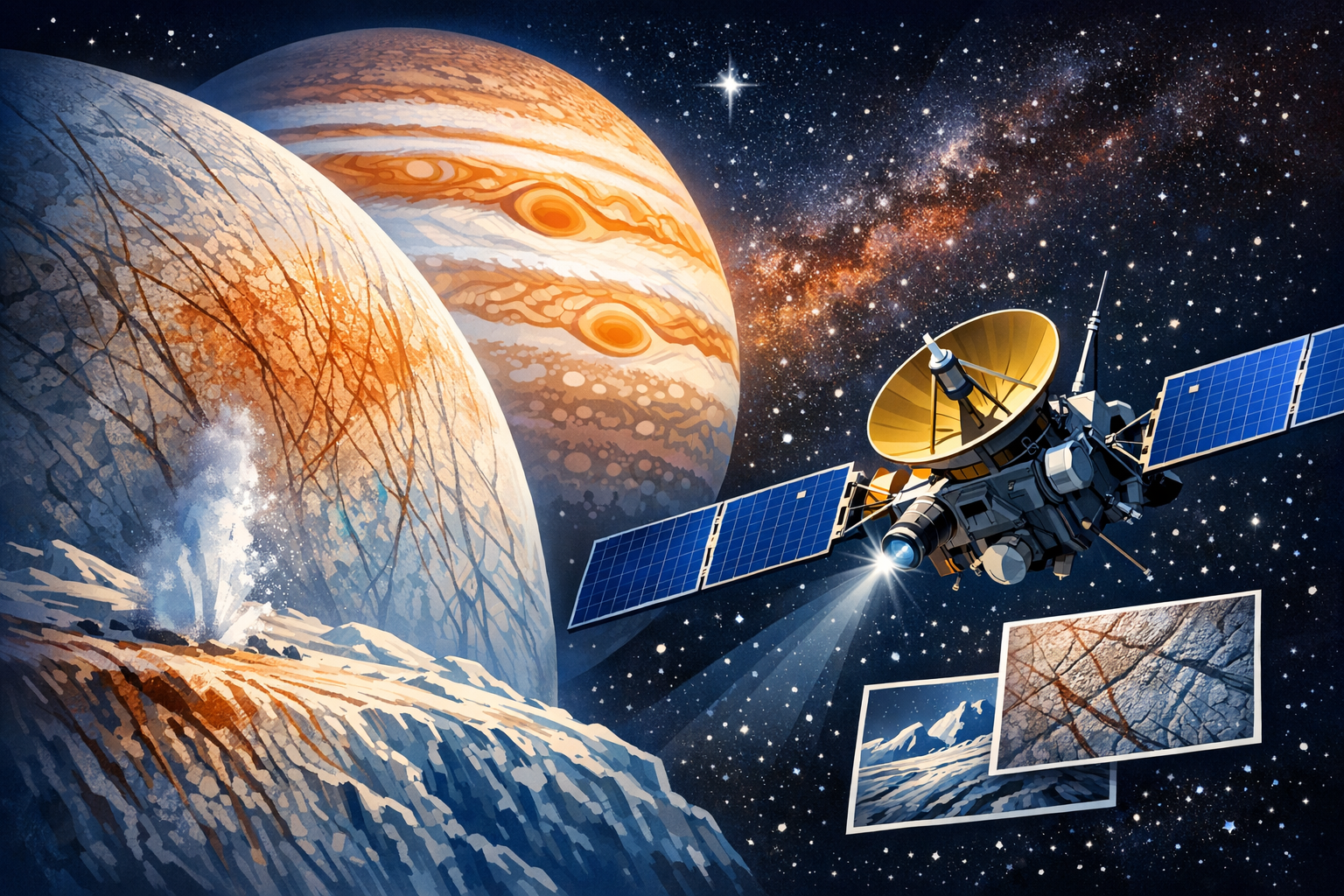
After years of anticipation and a journey of nearly 500 million miles, NASA's Europa Clipper spacecraft has begun delivering on its promise. The first batch of close-up images from Jupiter's moon Europa arrived at mission control last week, and they're already reshaping our understanding of one of the solar system's most intriguing worlds.
What We're Seeing
The images reveal Europa's ice shell in unprecedented detail. The surface, long known to be crisscrossed with reddish-brown fractures, turns out to be far more complex up close. Scientists can now identify individual ice blocks that appear to have shifted and rotated, much like tectonic plates on Earth but driven by tidal forces from Jupiter's immense gravity.
Most exciting are the regions where the ice appears thin or recently resurfaced. These areas could be locations where liquid water from the subsurface ocean has pushed up toward the surface, potentially carrying with it any organic molecules or chemical signatures of life that exist in the ocean below.
Why Europa Matters
Europa has long been considered one of the most likely places in our solar system to harbor extraterrestrial life. Beneath its frozen exterior lies a global ocean containing roughly twice the volume of all Earth's oceans combined. That ocean sits atop a rocky seafloor where hydrothermal vents could provide the energy and chemistry necessary for life.
The Europa Clipper mission isn't designed to find life directly. Instead, it's characterizing the moon's ice shell, ocean, and geology to determine whether conditions suitable for life exist. But even that more modest goal could fundamentally change our understanding of where life can emerge.
The Technical Achievement
Getting these images wasn't straightforward. Europa sits within Jupiter's punishing radiation belts, which can fry electronics in short order. The spacecraft is designed to make 49 close flybys rather than orbit Europa directly, dipping in for observations and then retreating to safer distances.
Each flyby brings the spacecraft as close as 16 miles from Europa's surface, close enough for its cameras to resolve features as small as a few feet across. The suite of nine scientific instruments aboard includes ice-penetrating radar, a thermal imager, and a mass spectrometer designed to analyze any material ejected from the surface.
What Comes Next
The first flyby was just the beginning. Over the next three years, Europa Clipper will build a comprehensive map of the moon's surface and subsurface. Scientists are particularly eager for data from the ice-penetrating radar, which should reveal the thickness of the ice shell and potentially detect pockets of liquid water within it.
For now, the scientific community is savoring a moment that decades of planning have made possible. As project scientist Robert Pappalardo put it: "We've been imagining what Europa looks like up close for 25 years. Now we don't have to imagine anymore."